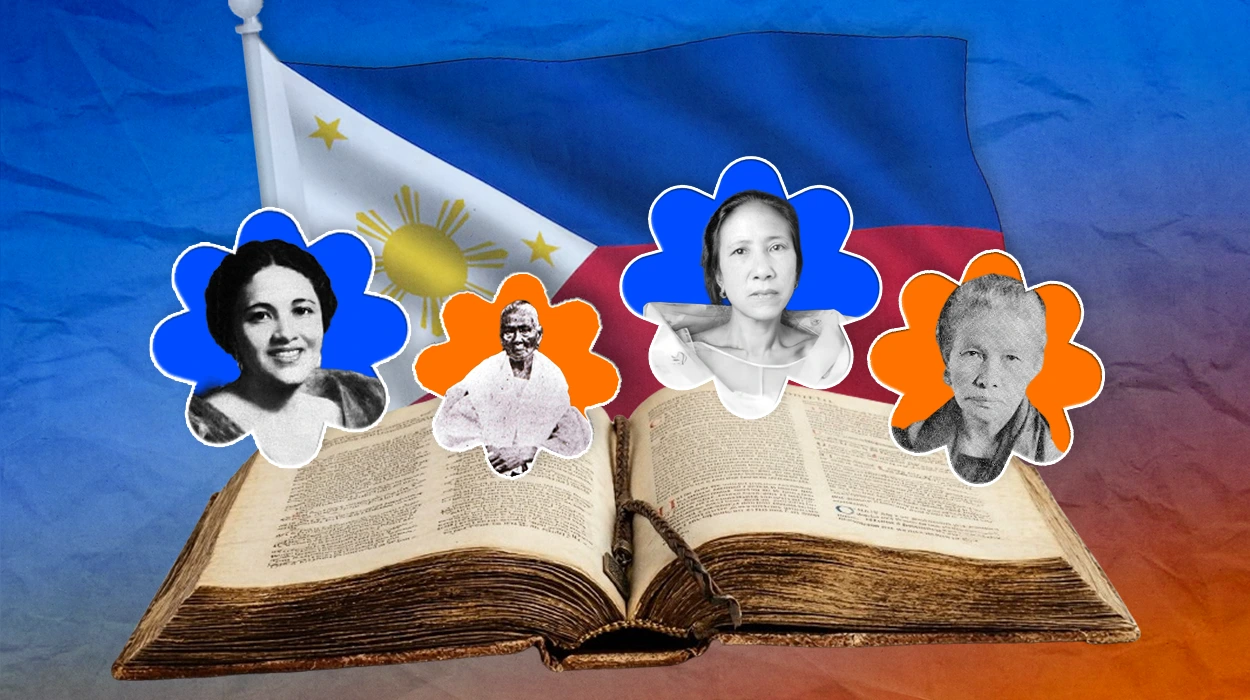
Philippine history is often told through the names of male heroes, such as José Rizal, Andrés Bonifacio, Emilio Aguinaldo, the list goes on. Yet the Filipino women who made history are just as deserving of that recognition. Behind every revolution, every social reform, and every scientific breakthrough, Filipinas stood at the forefront, defying societal norms and shaping the nation’s future. They just didn’t always make it to the textbook covers.
Filipino Women Who Changed Philippine History:
- Gabriela Silang
- Melchora Aquino
- Gregoria de Jesús
- Teresa Magbanua
- Agueda Kahabagan
- Pura Villanueva Kalaw
- Josefa Llanes Escoda
- Dr. Fe del Mundo
- María Orosa
- Corazon Aquino
Gabriela Silang – The First Filipina Revolutionary Leader
Most people know Diego Silang. Far fewer know that when he was assassinated, his wife didn’t mourn quietly. She took command. Maria Josefa Gabriela Cariño de Silang became the first Filipina to lead a revolt against Spanish colonial rule, commanding Ilocano forces for four months after her husband’s death in 1763. Her troops called her Henerala. History would later call her the Joan of Arc of Ilocandia.
She was eventually captured and executed on September 20, 1763, at just 32 years old. Her refusal to abandon the cause, when she had every reason to walk away, is the reason a prominent women’s rights organization still carries her name today. GABRIELA Philippines didn’t choose that name by accident.
Melchora Aquino – Mother of the Philippine Revolution
She was 84 years old when the revolution erupted in 1896. Most people her age would have stayed home. Tandang Sora opened hers.
Melchora Aquino turned her house in what is now Barangay Tandang Sora in Quezon City into a refuge for wounded Katipuneros, feeding them, treating their injuries, and sheltering them from Spanish authorities. When she was arrested and interrogated, she refused to give up a single name. She was exiled to Guam as punishment.
She came back. And decades later, her face appeared on the Philippine 100-peso bill, as the first Filipina ever to appear on Philippine currency. Sometimes the most powerful thing you can do is simply refuse to stop.
Gregoria de Jesús – Lakambini ng Katipunan
Gregoria de Jesús, known as “Oriang,” served as the custodian of the Katipunan’s most sensitive documents, seals, and weapons, a role that came with a very real risk of death. When Spanish authorities closed in, she loaded everything into a calesa and drove through the night to keep the society’s secrets safe.
She also learned to ride a horse and fire a rifle, fighting alongside the men in the field. After Bonifacio was executed in 1897, she spent years trying to recover his remains. She never stopped honoring his memory or the cause they shared. Her code name within the Katipunan was Lakambini, meaning noblewoman. It was well-earned.
Teresa Magbanua – Joan of Arc of the Visayas
A schoolteacher from Pototan, Iloilo who ends up commanding troops in the middle of a revolution is not someone you’d expect to find in the history books. But when the 1896 Revolution broke out, Teresa Magbanua defied her husband’s protests and followed her brothers to war, eventually leading them.
She became the only woman to lead troops in the Visayan theater during the Revolution, winning her first battle in Barrio Yating, Capiz on December 3, 1898. Her soldiers called her Nay Isa. She went on to fight in the Battle of Iloilo City and the Battle of Balantang, and is one of the very few Filipinos to have participated in all three resistance movements: against Spain, against the United States, and against Japan. During the Japanese occupation, she sold her personal belongings to buy food and supplies for local guerrillas.
She wasn’t looking for a title. She was unwilling to sit on the sidelines while her country burned.
Agueda Kahabagan – The Only Female General of the Philippine Republic
There is exactly one woman listed in the official roster of generals of the Army of the Filipino Republic. That woman is Agueda Kahabagan.
A native of Santa Cruz, Laguna, Kahabagan was reportedly spotted on battlefields dressed in white, armed with both a rifle and a bolo knife. She was commissioned by General Miguel Malvar in 1897 and played a key role in the 3-day assault on the Spanish garrison in San Pablo. On April 6, 1899, General Pío del Pilar formally recommended her promotion to general under Emilio Aguinaldo.
Not honorary. Not symbolic. An actual general.
Pura Villanueva Kalaw – Pioneer of Women’s Suffrage
Before she became a suffragist, Pura Villanueva Kalaw was the first Queen of the Manila Carnival in 1908, a title that eventually evolved into Miss Philippines. She could have stopped there. Instead, she spent the next three decades fighting for the right of Filipino women to vote.
She founded the Asociación Feminista Ilonga in 1906 and brought the first women’s suffrage bill to the Philippine Assembly in 1907. The all-male assembly rejected it. She came back the next year. And the year after that. It took 30 years.
When women’s suffrage was finally included in the 1935 Constitution, contingent on at least 300,000 women voting in favor, Kalaw organized a nationwide campaign. On April 30, 1937, 444,725 Filipino women voted yes. The fight was over.
Josefa Llanes Escoda – Founder of the Girl Scouts of the Philippines
Josefa Llanes Escoda graduated as a valedictorian, earned a master’s degree in sociology from Columbia University, and then returned to the Philippines to build something that would outlast her by generations. On May 26, 1940, President Manuel L. Quezon signed Commonwealth Act No. 542, officially establishing the Girl Scouts of the Philippines, with Escoda as its first National Executive.
During the Japanese occupation, she and her husband Antonio smuggled food and medicine into concentration camps for Filipino and American prisoners of war. On August 27, 1944, she was arrested and imprisoned at Fort Santiago. She did not survive.
Today, her face is on the Philippine 1,000-peso bill, alongside José Abad Santos and Vicente Lim, as one of the Filipinos who died resisting occupation. She is remembered as the Florence Nightingale of the Philippines, but her legacy reaches further than any single title can hold..
Dr. Fe del Mundo – Pioneer of Philippine Pediatrics
Dr. Fe del Mundo became a doctor because she lost three siblings in infancy and a sister to appendicitis. She graduated valedictorian from the University of the Philippines College of Medicine in 1933, then found herself enrolled at Harvard Medical School, which did not officially admit women at the time, making her likely the first woman ever to study there.
She returned to the Philippines and in 1957, after selling her home and personal belongings, founded the Children’s Medical Center in Quezon City, the first pediatric hospital in the Philippines. She also invented a bamboo incubator designed for rural health centers without electricity, authored the first local pediatrics textbook, and pioneered research on dengue, polio, and measles. In 1980, she became the first woman named National Scientist of the Philippines.
María Orosa – The Food Scientist Who Saved Thousands
María Orosa invented over 700 food products in her lifetime. You probably already know one of them. Banana ketchup was created as a wartime substitute when tomato supplies ran out. But her work went far beyond condiments.
Born in Taal, Batangas, Orosa earned her degrees in pharmaceutical chemistry from the University of Washington and returned to the Philippines committed to making the country self-sufficient through local ingredients. When the Japanese occupation began, her inventions became lifelines. Soyalac, a nutrient-dense soy drink, and Darak, rice bran cookies packed with Vitamin B-1, were smuggled into internment camps and saved thousands of Filipino, American, and other prisoners from starvation.
She joined Marking’s Guerrillas to fight for Philippine freedom. On February 13, 1945, the hospital she was sheltering in during the Battle of Manila was bombed. She did not survive. But the people who ate her food did.
Corazon Aquino – Mother of Philippine Democracy
When Benigno “Ninoy” Aquino Jr. was assassinated in 1983 upon returning from exile, his wife Cory was a private person, a mother, a widow who had no plans for politics. But when millions of Filipinos asked her to run, she said yes.
Corazon Aquino ran against Ferdinand Marcos in the 1986 snap elections. When Marcos declared himself the winner, Filipinos didn’t accept it. What followed was the People Power Revolution, days of protest on EDSA that ended a 20-year dictatorship.
Aquino became the first female president of the Philippines and the first woman president in Asia. TIME Magazine named her Person of the Year in 1986. Her presidency was not without its challenges, but what she restored, a constitutional democracy, a free press, and the right of Filipinos to choose their leaders, remains her most enduring legacy.
The stories above span nearly three centuries, from Gabriela Silang’s revolt in 1763 to Cory Aquino’s peaceful revolution in 1986. What connects all of them is a refusal to accept the limits that colonial rule, patriarchal tradition, or authoritarian power tried to place on them.
Philippine history is often told as a story of great men. But the country that exists today, its democracy, its healthcare institutions, its right for women to vote, and its cultural survival through occupation and war, was also built by these women. It’s past time their names were just as familiar.
Frequently Asked Questions
Who is considered the first Filipina revolutionary?
Gabriela Silang is widely recognized as the first Filipina to lead an armed revolt against a colonial power. After her husband Diego was assassinated in 1763, she took command of Ilocano revolutionary forces and led resistance against Spain for four months before she was captured and executed.
Who was the first female president of the Philippines?
Corazon “Cory” Aquino became the first female president of the Philippines and the first woman president in Asia after the 1986 People Power Revolution ended Ferdinand Marcos’s dictatorship. TIME Magazine named her Person of the Year in 1986.
Was there a female general in the Philippine Revolution?
Yes. Agueda Kahabagan is the only woman officially listed in the roster of generals of the Army of the Filipino Republic. She was formally recognized and appointed to the rank under General Emilio Aguinaldo in 1899.
Who founded the Girl Scouts of the Philippines?
Josefa Llanes Escoda founded the Girl Scouts of the Philippines in 1940 and served as its first National Executive. She was later executed during the Japanese occupation after being arrested for providing relief to prisoners of war.
Who invented banana ketchup?
María Orosa, a food technologist and pharmaceutical chemist from Taal, Batangas, invented banana ketchup as a substitute for tomato ketchup during wartime food shortages. She also developed Soyalac and Darak, which helped save thousands of lives in Japanese internment camps during World War II.
Who was the first woman named National Scientist of the Philippines?
Dr. Fe del Mundo was named the first female National Scientist of the Philippines in 1980. She also founded the Children’s Medical Center in Quezon City, the first pediatric hospital in the country, and invented a bamboo incubator for rural communities without electricity.
Who was the first Filipina to appear on Philippine currency?
Melchora Aquino, known as Tandang Sora, was the first Filipina to appear on a Philippine banknote. She is featured on the 100-peso bill. Josefa Llanes Escoda appears on the 1,000-peso bill.
M2.0 Communications is a Public Relations Firm that specializes in business, technology, and lifestyle communication. We offer a range of PR services including corporate communications, media relations, social media marketing, influencer marketing, and video production. Learn more about our work on our case studies page.